
The future for biodiversity in the Anthropocene
Project Duration
01 January 2025 - Ongoing
Project Location
Contact Information
Contact Person: Teddy Chikwane
Email: teddychikwane@gmail.com
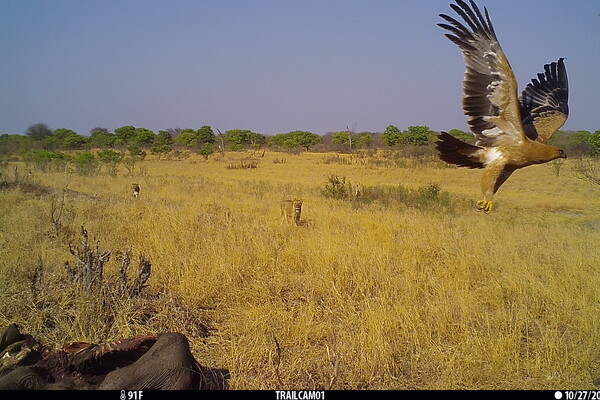
In Hwange National Park, increasing drought severity and high elephant densities generate episodic pulses of elephant (L. africana) carcasses, creating short-lived but abundant resource surges in the savanna. These mega-carcass events may profoundly reshape predator–prey dynamics, yet their cascading ecological effects remain poorly understood. The PULSATION project examines how elephant carrion pulses influence lethal (predation) and non-lethal (fear) interactions between apex predators, lions (P. leo) and spotted hyaenas (C. crocuta) and their herbivore prey.
Using GPS biologging, camera trapping, behavioural observations, playback experiments, and faecal DNA metabarcoding, we will quantify the spatio-temporal footprint of carcasses, assess shifts between scavenging and hunting, evaluate interference competition, and measure herbivore anti-predator responses near and far from carcasses. By testing hyper-/hypo-predation and hyper-/hypo-fear hypotheses, this project will clarify how pulses of mega-carrion restructure savanna food webs and highlight the ecological processes sustained by intact megafauna populations under climate change.

Zimbabwe Parks and Wildlife Management Authority

Zone Atelier Hwange The Hwange LTSER hosts a long-term interdisciplinary research project to understand the dynamics of a savanna socio-ecosystem, Hwange National Park (~ 15000 km²) and its periphery, located on the north-western border of Zimbabwe. This system, characterized by important environmental and societal changes, is part of the largest transboundary conservation area in the world, KAZA TFCA (Kavango-Zambezi Trans-Frontier Conservation Area).

CNRS Ecology & Environment: Develops and coordinates research in the fields of ecology and the environment, including into biodiversity and the relationship between humans and their environment.